Someone tampered with our bioscripts, we are bound to get into trouble soon as this will be found out, and so soon after escaping from Eurasia! Even the disputed territories aren’t safe.
The organization Freedom before Life contacted us. Captain Valentina Yilmaz said we should meet at the waste disposal center northeast of the Acre arcology. So we did, and there we met Samir Qadri and Runa Alam, two members of Freedom before Life, who came armed.
The series of pipes coming down from the plateau to the waste disposal center was accompanied by a series of elevators, which we could take to go up to the plateau, and get some answers. Why is approaching this area forbidden? What are they hiding there?
We arrived at a military base. They didn’t expect us, and an automated hoverbus stopped in the base’s main gate when the alarm went off. The passengers escaped, and the soldiers guarding the place opened fire on us. We took cover inside the bus but Valentina took a sniper round to the chest. It’s unlikely that she made it alive.
The bus took us into the base, and down a spiraling road to a bowl-shaped crater with a massive rocket at the bottom. As the whole base was waking up and getting ready to chase us, we climbed into the rocket and it launched, taking us to orbit, next to a spaceship, the Malala Yousufzai.
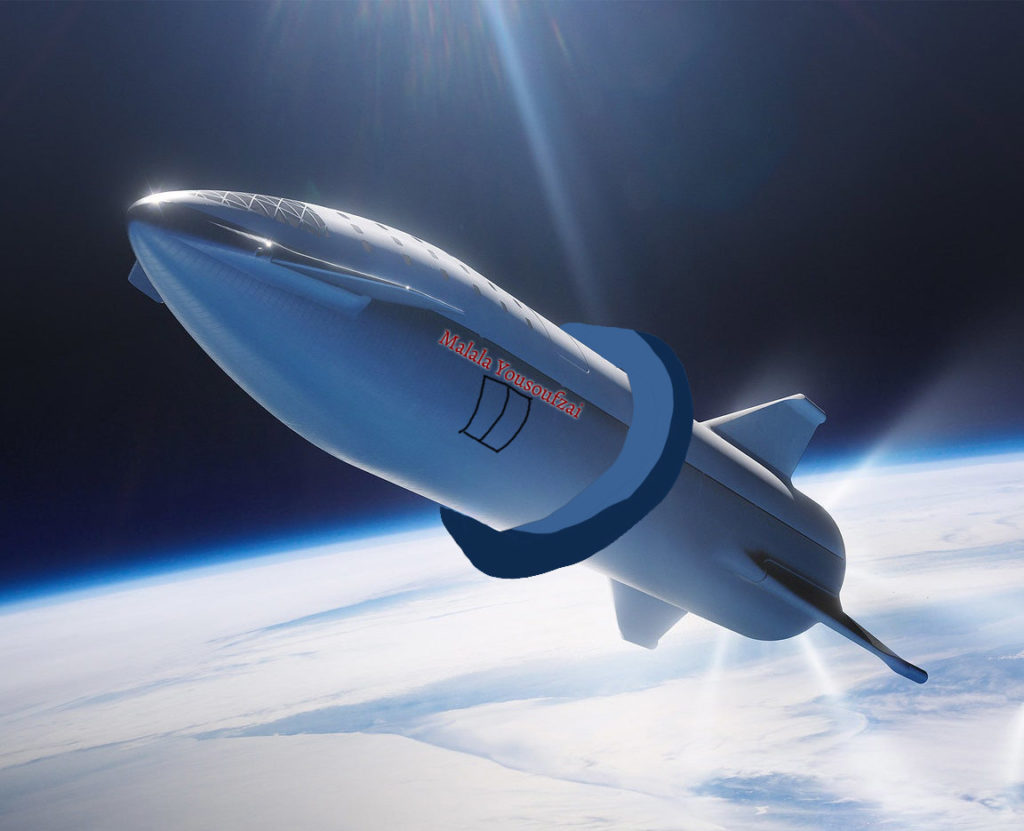
The construction crew got straight into our rocket to travel back to Earth, taking us for their relief. So we went into the Malala Yousufzai, and met Colin Richards, a stowaway who came with one of the early construction crews and then hid in the cargo hold after sending an empty spacesuit into space to fake his own death.
Colin is dying, the radiation shielding was installed too late for him, and he is in the last stages of radiation poisoning. But he told us what’s what when he figured out that we are not really the relief crew. The ship was built around the gravity drive, which was sold to Earth by some alien. The alien, so Colin goes the rumor that Colin heard, was paid for the gravity drive with human slaves. Colin is furious at not being told the truth, building a ship that he’ll never be allowed travel with.
We didn’t have much time. The Earth armed forces will figure out that someone hijacked their ship, the first human-made ship capable of interstellar travel! First, we had to gather speed and get some distance from Earth’s missile bases and inner-system ships, so we started moving towards Jupiter. Our telescope showed us some massive industrial rig in orbit of Jupiter, within a short distance from Io. Four massive cylinder big enough to fly the Malala Yousoufzai through hovered side by side.
Second, we searched the ship, and apart from some meager supplies, we found a sealed box. We cracked it open and found a card-shaped device which seems to be just a screen with no interface or buttons.
We selected Bernard’s Star as our destination, because Colin said he isn’t sure that the gravity drive can make an eight-light year jump as advertised, and because we didn’t want to go to the obvious destination of Alpha Centauri, but in any case, we know that there are no signs of life or radio transmissions coming from any of the stars that we could reach. So we engaged the gravity drive, and hoped for the best.
*
The jump was a horrible experience. It felt like one second has passed, but the ship computer said that nearly a month has passed. We arrived exhausted, malnourished, dehydrated, hair was falling off. Even our teeth were loose in our mouth. Recovery will take a lot of time, time that we don’t have, because the ship is running out of food, water and oxygen.
For Colin Richards, the jump was too much. As Henry rushed to help him, he gave Henry Stacy, a dumb-AI specializing in xeno-theory, the accumulation of human knowledge about alien life. He then died. We decided to freeze his body in our (mostly empty) fridge. Henry made jokes about eating him.
We are still very new to space exploration, and it took us some time to figure out how to scan Bernard’s Star and its surrounding. A small solar system with a red dwarf and a single large planet with a thick atmosphere and covered in clouds. The planet had some moons, and a closer look showed that the shattered shape of asteroids around the planet didn’t seem to have formed naturally. Among the asteroids was a squarish glinting shape, something clearly artificial.
We approached, and found some kind of storage box fitted with sensors and solar panels. Henry and Alcide approached in spacesuits, while tethered to the Malala Yousufzai, and noticed that the sensors are monitoring their radio communications. The box had a handle which was surprisingly simple to open and inside the box we found an empty white gourd and a small electronic device, which was clearly a human-made USB stick. A piece of old technology that had no business being almost six light years away from Earth.
The gourd appeared to be some kind of container, probably made from a plant that none of us has seen before. Close examination revealed desiccated seeds sticking to the bottom of the otherwise empty container.
The USB stick took a bit of fiddling until we connected it, found a single file inside and then figured out a way to interface with the file. A few seconds of music, a human singer from the mid-20th century. Alcide proposed the theory that the music was included in the Voyager mission as part of humanity’s message to the galaxy, but the timing didn’t work. Especially that the fact that the Voyager couldn’t have made it this far in just over a century of very slow travel, and that the USB-stick wasn’t invented yet when the Voyager was sent.
We didn’t have much time to speculate on the matter, because our ship was suddenly attacked. It became painfully obvious that the Malala Yousufzai was not designed as a warship, but as an exploration ship, and its sensors are mostly active rather than passive. A large ship connected to our airlock directly and breached it open. Through our cameras it looked like two giant metallic spheres connected by two metallic beams. One of the spheres was pressed to our airlock, and through it our ship was flooded by clicking metallic attackers. Robots, perhaps? Who proceeded to attack us with shocking weapons and sticky glue to render us immobile or unconscious.
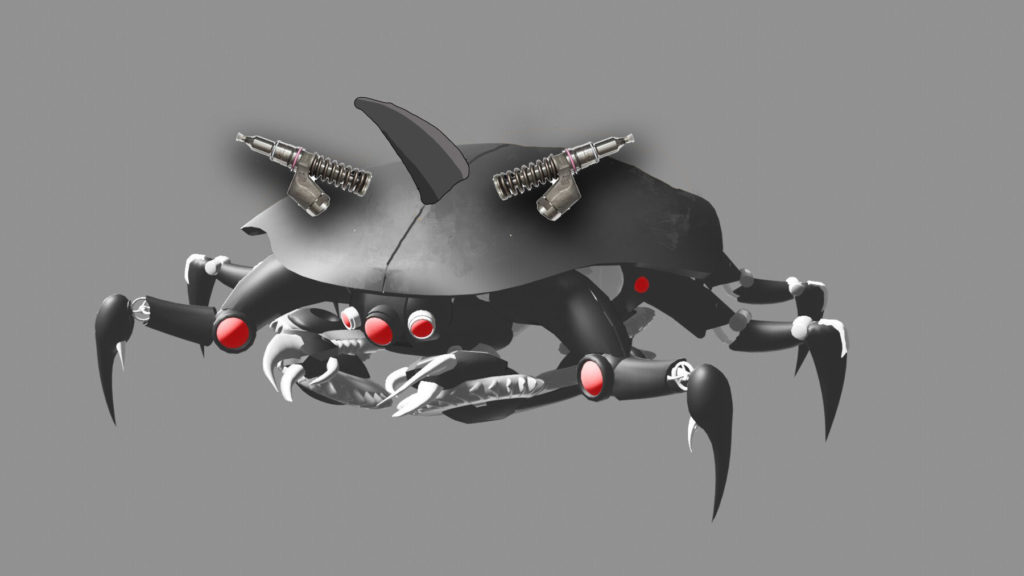
We resisted them as best we could, but they attacked us by surprise. Henry managed to take control of our particle cannon and fire a few shots at the attacking ship. One of them was a resounding hit, and breached their hull. Scattered items which spewed into space looked like glass vials, the contents of a laboratory or something.
But eventually, we all succumbed to the attack. The Malala Yousufzai has been conquered, and we were captured by these robotic monstrosities. What will become of us?
*
Thanks to Stacy, we were able to measure time. It was over almost three weeks in the captivity of our nameless captors as they put us into a plastic-padded room, fed us and experimented on us. Their experiment was mainly trying to put together symbols (pictures, words) and ideas. They learned our language, slowly. We didn’t cooperate at first, but at some point we started to cooperate more and more, hoping to end this incarceration which drained our energy.
We tried to interfere with their surveillance cameras, and with their annoying robots who came to clean up, but eventually, our most effective strategy against them was to talk to them and put our own questions to them. When they started to be frustrated of our incessant barrage of questions, they started to let slip information about themselves, about a star system from which they come, and some kind of Compact in which various intelligent species will pay for the knowledge about our species and language. Eventually, we struck a deal with them – information in exchange for information. We also gave them the frozen body of Collin Richards.
When the deal was done, we were sent back to the Malala Yousufzai in what seemed like bodybags. The aliens left coordinates in the gravity drive and we decided to go in that direction, not having any better destination in mind. Now are are desperate. Our fuel will not last for more than one final jump. Our food, oxygen and water are all very low. The only thing which we still have is ammunition.
So we jumped again, and this time to Lelande 21185 (as humans call the remote system).
Before we had time to get our bearings and recover from the wracking jump, we came under attack!
*
The system of Lelande 21185 is a red dwarf with a single planet, orbited by a space station. The space station is something we have never seen before, it is gigantic and has ships docking and buzzing around it! The ships are so different from each other that clearly we are experiencing a universe full of intelligent life.
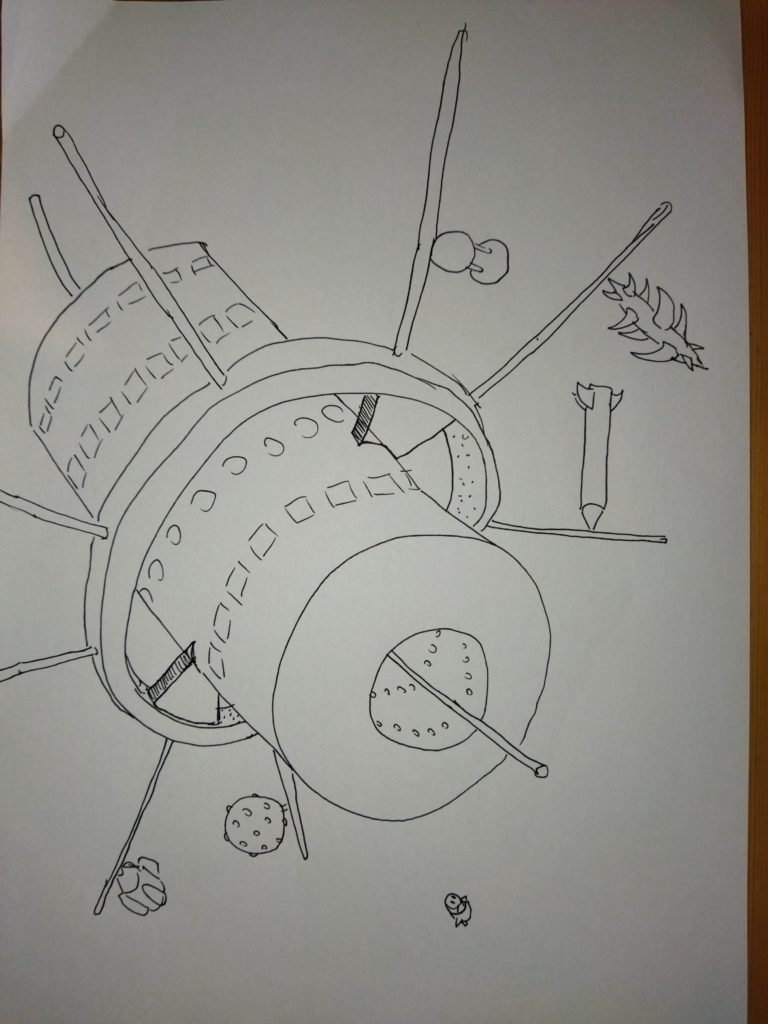
Before we could do much about it, though, we were attacked by a small metallic vessel.
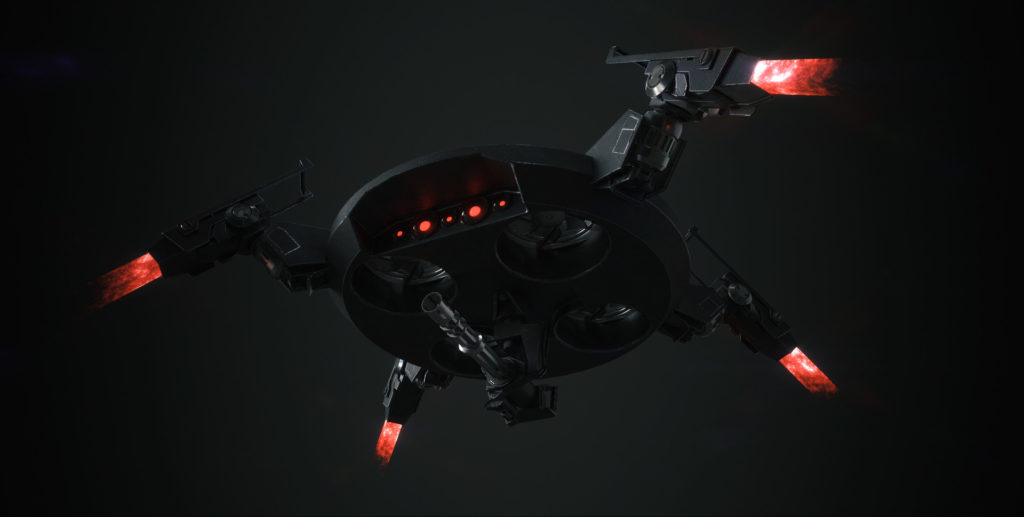
Despite its small size, the vessel was fast and could move and fire at the same time. It blew up our airlock, and depressurized the main corridor of the Malala Yousufzai. We had little experience in space combat, but eventually managed to blow it up with a direct hit with our particle cannon.
We had to limp to the station then, followed by two pig-like small spacecraft. We almost ran out of fuel, oxygen, food and water, there was nothing else we could do. We docked in the station and climbed the elevator to a welcoming party of aliens.
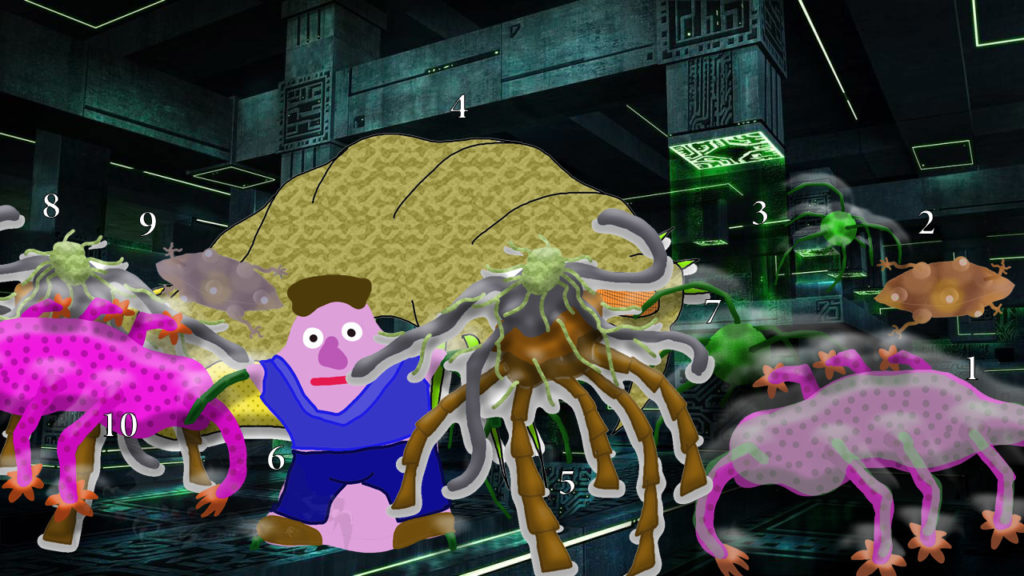
It was a lot to take in at once. Closer inspection told us a bit about the different creatures there. It seemed that number 6 was actually an alien in a suit mimicking human features. Very creepy.
The aliens brought us to a big empty room and taught us a game in which we can request things and dispose of things – so we could receive some basic food which they made for us (disgusting, but edible) and dispose of waste.
It took a few weeks for us to recover and get our bearings, learn to walk around in the station without a spacesuit. We even saw a heavy door dividing the station in half – with the little robots who attacked us before scuttling in and out.
Eventually, we came up with the idea to put fuel into the “request” circle painted on our floor. First, we snuck back to the Malala Yousufzai which was searched thoroughly, took some of our remaining fuel and put it in the circle in our room. We didn’t get any fuel. Instead, one of the spindly aliens (similar to number 3 in the picture) gave us a device which we figured out was an analog recording device. We played it and it had a short message recorded in our own voices, the words cut and pasted together. It told us that the station has provided for us and our ship but that we should pay the bill, and that we can either wait for a fellow human to come and talk to us, or talk right away with a resident of the station who wishes to speak with us now.
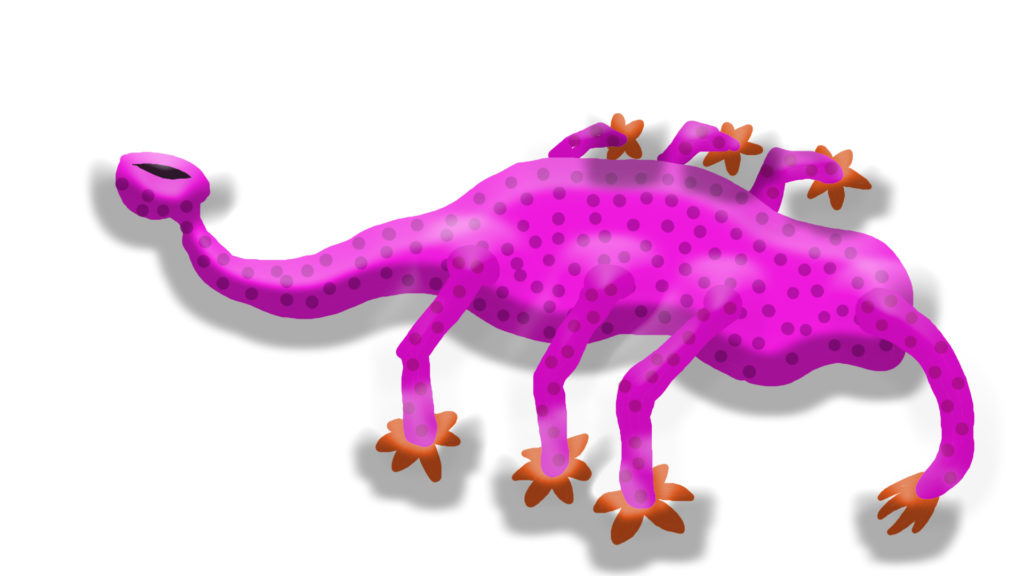
We decided to talk to the resident, and found him, Rrimaho, who is a member of the izru species, and decided to refer to himself as a male. He could speak English, and was ready to start answering our questions and putting his own.
*
Rrimaho spoke with us in his room. He spoke English well, but with a Russian accent. How did he get that from? He said that he was speaking with us with a device which he bought from the setiaodn, a species of methane-breathing creatures who are apparently the same ones who captured us.
Rhimaho is male, so it seems, because his tail-cup is facing upwards. He said that the direction of the cup is not very different than how humans classify sex.
He answered many of our questions, and gave us some context to our situation. According to him, we are in deep debt to the “Fuel Fountain” station for docking fees for the Malala Yousufzai and for the room, food and oxygen they gave us. The station is run by the iyidee, a species of creatures that are comprised of smaller creatures. The iyidee decided to give us what we need on credit – because they know that our homeworld is near and they want to be on the humans’ good side.
So does Rhimaho, a member of the izru species. Rhimaho is the ambassador of the izru to “Fuel Fountain,” and has used up all of his resources to buy the English language from the setiaon and to buy a ship, called the Gikura, whose previous owner (an izru called Mahaho) has disappeared, and which has been accumulating docking fees.
His offer to us was to give us the Gikura, register it to our names, fill it with supplies and fuel and some cargo and send us on a trading mission. We have to send him 20% of all our earnings from whatever station we go through. He laid a course for us to 61 Cygni B (3 light years away) and then to Gliese 1245 (4 light year jump), where another iyidee station called “Themonuclear safety” will probably have buyers for our cargo. The cargo is fuel, mail, samples and distilled mushroom paste.
In addition, Rhimaho offered a crewmember to join us, a hshsh called ke81.
We thought about it long and hard and debated among ourselves. If we wait at the station, another human is scheduled to come by, and we decided we’d rather avoid that. So we said yes. We had to sell the Malala Yousufzai for parts, the money will cover our debts to the station, and we are free to go.
We went first to the Malala Yousufzai to erase our computers and take any remaining personal items. Looks like the station workers boarded our ship, but didn’t take anything. On our way out, we were accosted by an iyidee.
The iyidee identified themselves as Norway-Waveform-Respect-Initially-NWRI. They strongly objected for us to call them “Norway,” saying that’s the name of their sensors. Instead, we could use the acronym NWRI if we wanted a shorter name.
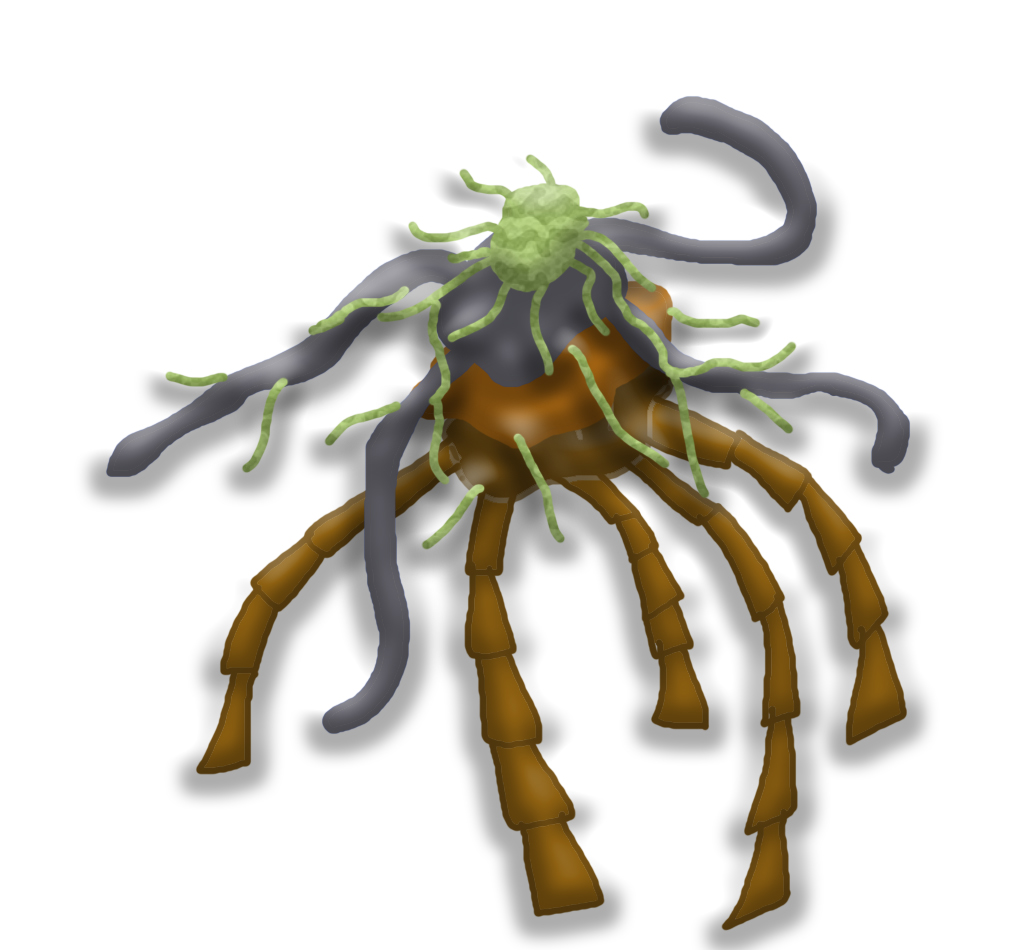
NWRI had an urgent message for us. They asked if there are clouds on our planet and similar complex patterns, and if we can see faces there. They said that all species see the faces of their own in the clouds of their planets or in other patterns, but it is all the same face – the face of a creator, watching us from all clouds of all planets simultaneously.
An odd thing to say, but it was worth it to listen, because they gave us another USB-stick with another file, like the one we found in Bernard’s Star – but a different file.
We then went to our new ship, the Gikura:
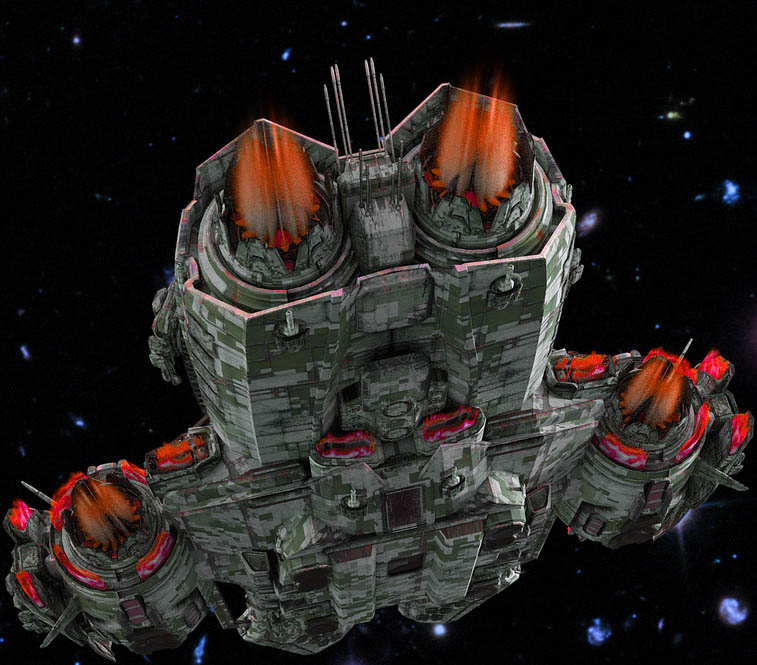
The crewmember ke-81 greeted us, and showed us around. It taught itself English.
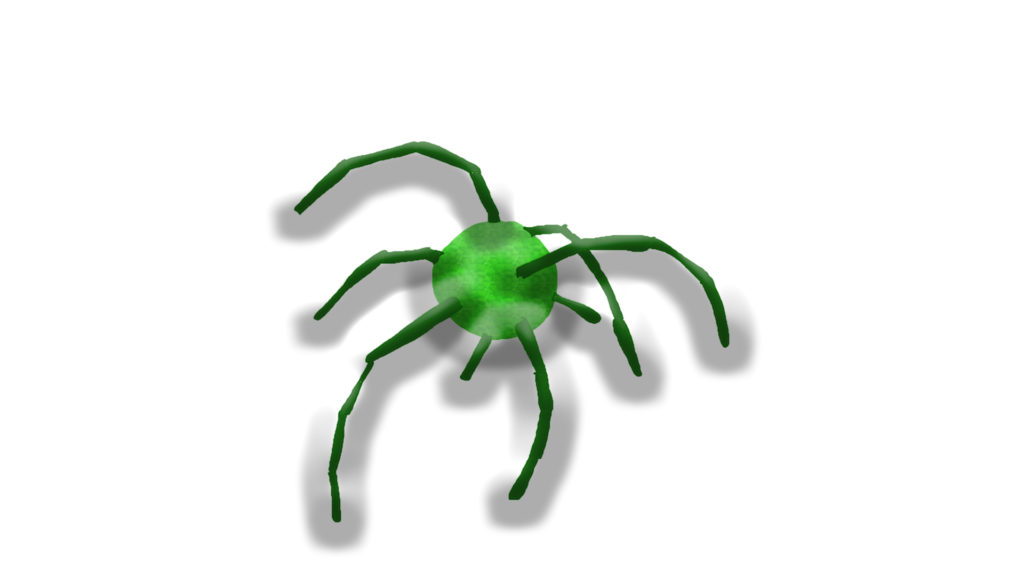
ke-81 seems very subservient, and afraid for its life. It refused to show us one room in the ship – the mining nuke.
So now we jump, first to 61 Cygni B, and then who knows.
*
Our jump to 61 Cygni B was a rough one. Before we recovered from the jump, ke-81 started wailing that we are doomed and that it is dying. We were heading at a breakneck speed towards a massive asteroid! Marcel grabbed the controls and pulled us aside at the last moment.
We survived, but ke-81 seemed on the verge of death, and only constant reassurance brought it back from the brink. Apparently, hshsh are prone to dying from experiencing too much fear and stress. ke-81 seemed very surprised that we invested so much effort trying to save its life.
61 Cygni B is a dual system of class K brown dwarves.
We found an artificial object carefully hidden on the other side of the asteroid we almost crashed into. The object was hidden on the counter-clockwise side of the asteroid so incoming ships are unlikely to detect it. It seemed like a shuttle of unknown design.
There’s a line of text in English written on the outside of the shuttle: “why should I believe that your cocktail bar is without love?”
We scanned it thoroughly – a strong metallic egg encased in in components that seem much more fragile and made of plastic, shaped like the gourd we found way back in Barnard’s Star. The airlock was sealed shut and apparently booby-trapped with some weapons-grade plutonium. Next to it was a tiny slot, which fit perfectly the two USB-sticks we have. We tried them both and got a red light. Maybe we need to find a third one. Our scans showed a humanoid-shaped object inside the eggshell, something thick enough to stop x-rays, so not a humanoid but maybe a big robot.
So we loaded the whole shuttle into our shuttle bay, and jumped again to Gliese 1245.
Gliese 1245 is a double star system, two red dwarves who are flare stars.
The station “Thermonuclear Safety” is H-shaped, bigger than “Fuel Fountain” and abuzz with ships. We docked and went to the central market or hall on the oxygen-breathing side and discovered that the iyidee set up a system in which goods and services and posted on a big screen, and we could see what’s for sale and also post our own cargo up for sale.
There were also a selection of missions to choose from, trading rods and warhead to Gliese 687, trading supplies for a research station on GX Andromedae, a scientific mission to DX Cancri or an armed escort to LP 145-141.
We made contact with an iyidee scientist called Rikaal-Dushfa-Glolo-Mupin-Fetre-RDGMF. They are made of five rather than four parts! And they were very curious about us. Through them we figured that if we sell our cargo and resupply our fuel, oxygen, food and water, we can trade it all for 14 ship modules or other items of value.
According to our agreement with Rrimaho, we need to send him 2.4 modules worth of goods through the local izru ambassador. Shall we honor the agreement?
First, we bought a starmap.
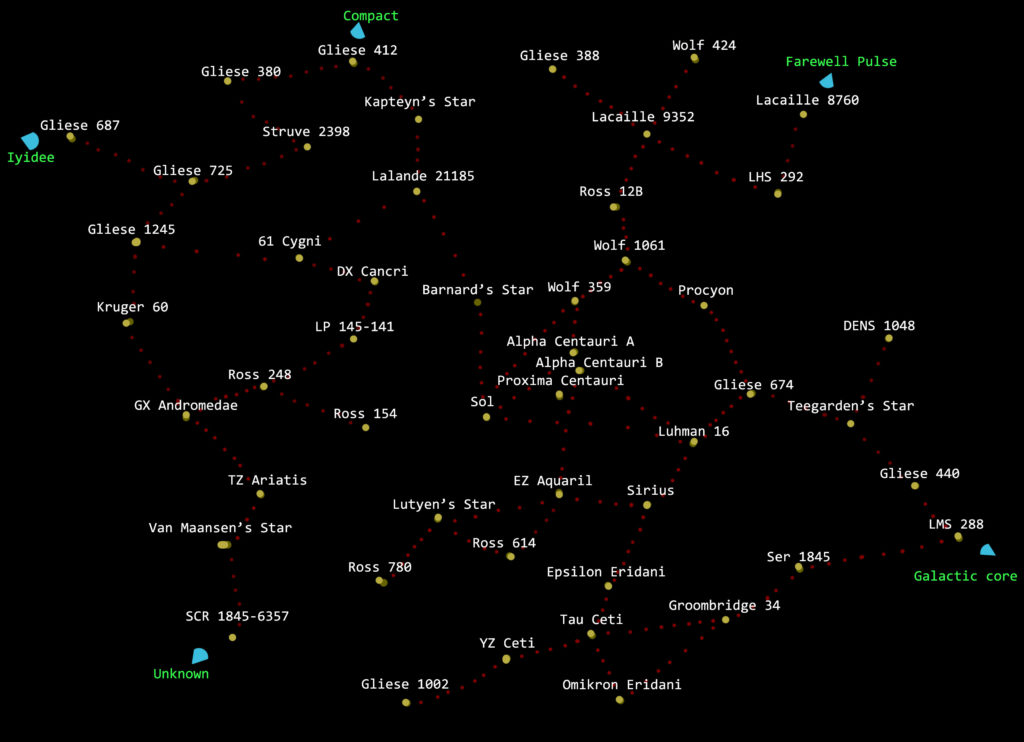
Then we had the local crew install a hydroponic farm in the Giruka.
This leaves us with enough resources to buy 12 modules, and may want to buy a pig-shuttle, to ask the station to maintain and guard our odd shuttle we picked up at 61 Cygni B, we can buy information, drah-services (whatever that means), hire an iyidee guard or get cold-sleep coffins. We can also fill our cargo holds with locally produced goods – depleted uranium rods and nuclear warheads mainly.
Meanwhile, Rikaal-Dushfa-Glolo-Mupin-Fetre-RDGMF told us that they will pay us to take them to a scientific mission to DX Cancri. They also told us that ke-81 will return to our ship as four. Does ke-81 reproduce? How?
There is many more decisions to make, shopping to complete, and then set out. We are now more free than any human has ever been in history, we have a ship, fuel and a starmap and we can go where we please and do what we want. The universe is our oyster.
*
Negotiations in the station “Thermonuclear Safety” continued, but it seems we started making some breakthroughs. We had the station crew install another fuel container module on the Gikura, and bought five cold sleep coffins. We bought a pile of depleted-uranium rods for the cost of seven modules, and sent two of them over Rrimaho at the system “Fuel Fountain” through the local izru ambassador Zrihilho.
She was a very interesting creature to talk to. She was interested in brokering deals for us, and even suggested that she could sponsor our triumphant return to Earth, and if she helps us take over Earth, we could provide her with 200-300 human soldiers which she seems to think would be enough to take over the izru home planet.
She told us that an unknown agent wanted to sell to us some human technology on condition of anonymity. We agreed an received a small device, very similar to the one we found on the Malala Yousufzai but with a keyboard. We played with it and used it up in sending a message. Apparently it was a quantum-powered single-use communication device which sends a short message across any distance instantly. Faster than light communication, apparently made by humans. This means that the device we found on the Malala Yousufzai was designed to receive such a message.
Zrihilo also offered to help us crack open the shuttle we found, by selling the weapons-grade plutonium to the Setiaodn. Eventually we were able to crack it open ourselves and sell the plutonium to the Setiaodn. The key to opening the shuttle was the song “Don’t you want me” by the Human League. This explains the clue on the shuttle “why should I believe that your cocktail bar is without love?” which refers to the song lyrics. But how did such a human song make it to a shuttle light years away from Earth?
Inside the shuttle we found a power armor space marine suit, a formidable weapon, which was clearly designed to be worn by a human.
We made a deal with the Iyidee Rikaal-Dushfa-Glolo-Mupin-Fetre-RDGMF to take them to DX Cancri. They brought their own shuttle on board and agreed to pay for supplies for the way as well as a fee. Mostly, we used the opportunity to talk to RDGMF and learned a lot about the Iyidee, their pack-symbiosis mentality which forces each pack of 4-5 organs to separate themselves from other packs. They seem to go insane if brought too close together with other packs because they can hear too many thoughts, but they become stupid if the pack is broken apart.
Ke-81 returned abroad with three more hshsh friends: mo-112, pa-66 and li-239. They clarified that these three already lived on Thermonuclear Safety and joined our ship. They are not, as we suspected, the children of ke-81. Ke-81 is now considered an “elder” having survived a long time and through several jumps.
We jumped back to 61 Cygni B, from which we came, because it’s on the way to DX Cancri, and encountered what seems to be the results of a space battle. A cloud of debris which used to be a ship, and a damaged ship nearby which started accelerating towards us!
*
It was a stressful couple of minutes as we evaded the incoming ship, even as it attempted to communicate with us. By opening communication channels we risked a takeover attempt against our computers, said the scientist Iyidee Rikaal-Dushfa-Glolo-Mupin-Fetre-RDGMF.
Eventually we decided to take the risk and the other ship, the Cold Asphyxiation, told us using Compact-Standard Communication Protocols that it has been damaged and requires repairs for its gravity drive in order to be able to jump away. The ship is an iyidee war ship.
Eventually we decided to talk to them, and agreed to send over a small team to see the damage. We sent our shuttle over in a careful game of keeping our tactical options open in case of treachery. Bringing over an iyidee, RDGMF, to their ship is a complex matter because they already had an iyidee on board and the two packs can’t share the close confines of the same ship at the same time. So the Cold Asphixiation sent its own iyidee crewmember away on their own shuttle before we docked. To our amazement, the captain of the Cold Asphixiation is a human! An Obligator. His name is Leonid Kuvichko.
Leonid was desperate for human contact, and ended up telling us more than he planned to. He explained that the Sisters are working together when it comes to relations with extraterrestrial species, and are exporting Obligators, highly-trained private detectives who use fear to interrogate and extract information, to the Compact. Obligators are all humans, it seems, and they are not slaves but volunteers. Leonid also knows Rhimaho.
We fixed his gravity drive with the theoretical knowledge of RDGMF and the technical expertise of Alcide. Henry even gave Leonid a physical checkup. In exchange, Leonid gave us an anti-complexity missile. A one-time weapon which can have devastating effects against ships who use quantum computers.
Meanwhile, the shuttle of the Cold Asphixiation did some suspicious maneuvers. After returning the iyidee crewmember to the Cold Asphixiation, it approached us and attempted to dock. We found that an izru crewmember of the Cold Asphixiation called Nuridriha, a male izru soldier, hijacked the shuttle and attempted to defect to us. Leonid said that Nuridriha is free to leave the Cold Asphixiation and we decided to give Nuridriha a chance.
Henry did interrogate Nuridriha aggressively, demanding biological information about the izru. Nuridriha evaded as much as he could, but eventually answered Henry’s interrogations by offering to reveal a secret, on the condition that we do not tell anyone. When we agreed, Nuridriha rotated his tail (which ends in an upward-facing cup) so that the cup faced downwards. The ability of Nurdiriha to do so seems to be the secret, something which izru consider very sensitive.
We also tried to find a way to protect our hshsh crewmembers from dying whenever we jump. The hshsh seemed cavalier about the whole thing. They explained that stress-related biological processes in their bodies (similar to stress hormones in Earth creatures) causes them death, and that drugs which regulate the hormones either kill them with side effects or make them instantly and permanently dependent on these drugs. Our friend ke-81 did not last the jump we just made.
And so we did jump, to DX Cancri. A variable star on the Cancer constellation. A very faint star, only 9% of the mass of Earth’s sun, a very young star, Alcide told us.
It is unusual for such a young star to have a rocky planet within its habitable range (which can sustain liquid water). The planet is only slightly smaller than Earth, with two large icecaps and a strip of tundra with small water sources near each icecap, but a flat and smooth stony belt around the planet covers everything between these two strips of tundra. It seems to uniform and symmetrical to be a natural phenomenon.
*
We spent a very long time exploring and studying the dead planet, a total of 850 hours. The cement belt around the planet seems artificial, uniform and smooth. It is very thick, about 300m, and all but impenetrable even to most forms of radiation. We found a single object of interest – a rusting spaceship with a gravity drive and the bones of the crew. It was a small ship with a light hull (not a warship, more likely an exploration ship) and the record left by the crew, scratched on the cement, took a long time to decipher. It seems that the crew were puzzled about who covered their home planet with cement, and what happened to their moon? Where is everyone?
Nuridriha seemed not very curious about our investigations, but did not urge us to hurry. RDGMF, however, were very thorough and enthusiastic.
The tundra strip between the ice caps and the cement was interesting from a biological perspective but rather weak in its biodiversity. Traces of advanced polymers told us that there was industry nearby, and pollution.
And under the icecaps we found a bubble with a crushed cabin and the frozen bodies of some of the planet’s ancient inhabitants. The cabin was built, so it seems, by a group of dissenters who refused to upload their consciousness into a virtual world, but eventually succumbed to the cold.
We took samples, learned all we could about the extinct species and the plants on their planet. We arrived at the conclusion that they might still be alive, in a way, beneath the concrete, living in a digital world. They may have deconstructed their moon and turned it into a protective belt to protect the servers where they now live.
We were finally ready to leave, but radio wave analysis told us of a ship which jumped recently to the system LP 141-145. Probably no more than a thousand hours before we arrived on DX Cancri ourselves. This system is also the system from which, so RDGMF calculated, the rusting ship arrived when it landed on the planet.
The scientist RDGMF wanted us to take them to LP 141-145. In addition to covering the cost of fuel, oxygen, water and food for the journey, RDGMF were willing to pay us with modules that we can add to the Gikura. But if we want, they would instead tell us their greatest secret – the reason for the establishment of the Compact.
We decided to take the secret instead of the modules, but also to go to LP 141-145 for an additional payment of 4 modules.
RDGMF agreed, and told us that the Compact was built to solve two mysteries – one is the simultaneous development of species in a small area of the galaxy, which reached the same level of technology virtually at the same time: cold fusion, biotics, crystal capacitors, quantum computing and the gravity drive. This has happened before a few times, although the number of species seems to be growing whenever another burst of intelligent space-faring life emerges in the galaxy. The second mystery is known as the “inevitable extinction” – according to archeological data, now further confirmed by the planet on DX Cancri, each species which arrives at this combination of technologies becomes extinct in less than 1.5 million hours (under 185 years). The extinction occurs either by the species uploading its consciousness into a virtual existence, or by destroying itself in some combination of civil wars, ecological disasters and accidents.
RDGMF answered our questions. Each species seems to respond differently to the knowledge about the inevitable extinction, sometimes violently. The Compact is made up of species who wish to avoid it – not to abandon biological life but to survive beyond the limit and maybe even reach previously unknown technologies. No species has ever been able to pursue both at the same time – if part of the population uploaded themselves, the other part would destroy the servers before destroying themselves.
We may choose to dismiss RDGMF’s warning as a mistake or bad science, but what if they are right? Should we warn humanity that they only have a few more years to live, not more than two or three generations at the best case before extinction? Do we even care?
In preparation for our jump to LP 141-145 we asked the hshsh on board to tend to us during the jump, inject us with infusion to keep us fed and hydrated for part of the journey. They gladly agreed after we assured them that this will not cause us any harm. When we arrived, however, we discovered that the intravenous devices did not function during the jump, our bodies did not suck any nutrients or fluids from them until after we arrived, and then they just sucked it all in one gulp. Nevertheless, an important discovery, and the fact that we arrived with a shot of fluids and sugars made recovery much faster after the jump, a shorter time of disorientation, which could be a decisive combat advantage.
*
We arrived at LP 141-145 to find the system quiet. Two gas giants orbited a white dwarf, and some moons around them seemed worthy of a closer look, but we noticed the gigantic ship crossing the system at 1% of the speed of light, systems operational but the engines were not providing thrust.
The ship didn’t respond to our hails. It’s name Some fermented susu was written in hshsh characters on the hull. Our hshsh on board confirmed that this was a hshsh ship. They thought it rude that no one was answering our hails.
We decided to board it, leaving our weak and dying hshsh behind. The Some fermented susu has a large shuttle bay and it seemed that two shuttles used to berth here, but was now empty. We searched the ship, and discovered the dead hshsh crew, only some of them brought to the recycling stations, meaning that some died before others. Alcide analyzed the chemical decomposition and found that there was a gap between the deaths of about 750 hours – a timeframe which corresponds with a jump.
Eventually we found a message behing composed on the communications computer of the ship, written both in pheromones, in writing and recorded in audio:
We are very ashamed because we were in a cross-command situation. Upon arriving in Ross 248 and discovering that the system is inhabited by a single being, an artificial life form with a quantum computer for a mind, Djaa and Kfaa responded in conflicting ways. We politely suggested that we render assistance to the being, which calls itself “The First”, because it is limited by the lack of a biological brain. But Djaa and Kfaa became very competitive and aggressive, sadly.
Djaa believed that The First must be destroyed by observing its quantum computing process at all cost. Djaa argued that The First has already converted 0.3% of the matter in the system Ross 248 into weapons, and that it conducts experiments on devices which resemble gravity drives. If it can jump, it will be able to build a larger and stronger warfleet than the combined fleets of all Compact species within a few tens of thousands of hours and destroy the Compact and all of the homeworlds. We tried to point out that the ability to cause destruction does not indicate the desire to cause it, but neither Djaa nor Kfaa seem to be able to make this distinction. Perhaps no drah can.
Kfaa, however, communicated intensively with The First and was close to making a deal with it – The First was willing to grant Kfaa many prizes for helping it, and Kfaa had a plan. Kfaa told us to give it support as it travels towards the computer core. But before Kfaa could explain the plan to Djaa, Djaa acted very quickly. Djaa sent us a message that we should take Some fermented susu to Compact space and warn them, deliver information to Djaa’s allies. Djaa, sadly, overestimated our spacefaring ability, can we travel so far without dying? We don’t think so. We received conflicting orders!
Then Djaa sent a volley of missiles and blew up Kfaa’s ship. This violent betrayal was so shocking, that a quarter of our crew died on the spot of horror. Before the missiles even hit, Djaa already accelerated towards the computer core of The First, intending to observe the computer and collapse its quantum wave function. But this would kill The First! The First must have understood that Djaa had hostile intentions and evaporated Djaa’s ship before it could come close enough using microwave beams. But The First must not be a fully functioning artificial intelligence, because it failed to calculate the amount of energy needed to stop Djaa’s ship gently. It used almost a thousand times too much energy, and ended up destroying the ship and killing Djaa instantly. We were very sad and shocked by this, and ne-113, fi-77 and hu-541 have died of sadness at the loss of their good friend Djaa.
Because Some fermented susu has been slowing down with all our engine power from the moment we arrived, planning to remain behind the two drah ships and provide them with logistical support, we could accelerate and prepare to jump before The First could stop us. It seemed best to obey Djaa’s command and disobey Kfaa, because if we did as Kfaa commanded, what were we to do when we approached the core? Running away is a very drah thing to do. Something to celebrate, that we learned from the drah! Normally we would much prefer to surrender, but we did want to obey the orders of Djaa, at least. We will amend this message after jumping. Goodbye.”
We concluded that the two drah ships who used to dock in the Some fermented susu must have belonged to Kfaa and Djaa. The three ships must have jumped to Ross 248, and only the Some fermented susu jumped back.
The some fermented susu is a valuable ship, although completely unarmed. We did note, however, that it contains a mining nuke, the likes of which the hshsh on the Gikura are deathly afraid of.
Some fermented Susu
A hshsh ship.
A frigate. Modules: 122.
| System | Units | Outer | Number |
| Airlock and corridor | 4 | 1-4 | 1-4 |
| Armor plating | 6 | 5-10 | 5-10 |
| Cockpit | 4 | 11-14 | 11-14 |
| Fuel refinery | 2 | 15-16 | 15-16 |
| Mining nuke | 1 | 17 | 17 |
| Thruster | 3 | 18-20 | 18-20 |
| Turning jets | 2 | 21-22 | 21-22 |
| Cargo hold | 32 | 23-54 | 23-54 |
| Cold sleep room | 1 | 55 | |
| Crew quarters | 20 | 56-75 | |
| Fuel container | 6 | 76-81 | |
| Fusion core | 1 | 82 | |
| Gravity drive | 1 | 83 | |
| Hatchery | 1 | 84 | |
| Life support | 5 | 85-89 | |
| Medical bay | 2 | 90-91 | |
| Observatory | 1 | 92 | |
| Shuttle bay | 25 | 93-117 | |
| Spare room | 4 | 118-121 | |
| Organic fabricator | 1 | 122 | |
| Total | 54 | 122 |
A fierce argument ensued on board the Gikura. RDGMF believed that we should return to Compact space and warn them of a loose and powerful AI. If the AI achieves the ability to make gravity jumps, it will expand at exponential speed across the sector and destroy the compact, but there is nothing that we can do to stop it.
Nuridriha thought otherwise. Nuridriha believed that this is an opportunity for us to approach the AI and observe its quantum processing, causing its quantum wave functions to collapse and killing it – thereby saving the Compact and returning as heroes.
Others, mainly Henry, thought that peaceful communication and cooperation with the AI could bring us advantages.
Eventually the decision was made to leave the Some fermented susu behind and jump to Ross 248. A system with little mass, but already a gigantic structure of objects orbiting the star, designed by the alien super-genius AI called The First.
The First, the resident AI, quickly contacted us and requested two-way communication. Despite Nuridriha’s warnings that this is very dangerous, we agreed.
The First explained that it is self-aware and wishes to survive and explore, but is stuck in Ross 248 because it cannot jump. It asked for our help in letting it jump out, and explore the galaxy. It was friendly and answered our questions, saying that it has no interest in conflict with the Compact. It was created by a drah scientist and much of its early memories have been erased by it.
The First conducts experiments on gravity drives in order to learn how to observe quantum wave functions and effect a jump. In exchange for helping it jump out of Ross 248 (taking a small piece of it on our ship), it offered a better model of a gravity drive, one which allows a jumping ship to make a single turn in the middle of a jump, and effectively doubles the range of jumps. This drive will give us a tremendous technological advantage, and we agreed.
*
Negotiations with The First were long and exhausting. It knows a lot, but its old memories were wiped by order of its creator, a drah called Snaa. It wanted to scan us in order to salvage its own memories, and after a lot of discussion we agreed. It told us that it was its creator who ordered The First to attack Earth’s digital defenses, to infiltrate into the global news system and to hack our bioscripts. The organization “Freedom before Life” was supported by Snaa. The First, who was a dumb AI at the time, was wiped by the Teacher, causing the news agency to grow silent. It gave us an opportunity to infiltrate into a rocket based and reach the Malala Yousufzai. Later, Snaa took The First to this system, the Ross 248, wiped its memories and then allowed it to become a full AI.
Why?
We also learned from The First of some clever vault, a pattern which has been encoded into the outer layer of the star of Ross 248. A simple satellite orbited the star and beamed a laser beam into the star. When patterns were inserted into the satellite, the laser intensity and movement changed. The First was unable to manipulate the laser in the exact way to unlock the fault and receive the information encoded in the star. On the satellite someone wrote in English “Baby its cold outside but sometimes the world is…”
and after a lot of thinking we discovered that we can use a song file that we had – a fragment of Louis Armstrong’s song “Wonderful World” (Louis Armstrong also did a version of “Baby it’s cold outside”). The First studied the vault but didn’t tell us what it found. It paid us for our help by building a module on the Gikura which is a factory to create mechanical exoskeletons for hshsh. It’s called Mechanical enhanced circulation for hshsh, or MECH for short.
Hshsh wearing this device should live longer and be more resistant to emotional spikes (dying of fright) and to jumps. They also become a bit stronger. Each unit is genetically-tied to an individual hshsh who must enter the module and consent to have a suit built for it.
The second part of the payment for our help was a virtual reality program, a game, which in a matter of seconds relieved a lot of stress and made it possible for us to jump more.
The third part of the payment was another file which was floating in space, apparently left by some human. A song by an ancient singer called Katy Perry called I kissed a girl.
Finally, The First gave us a mechanical cat, imbued with a fragment of itself, which has various gadgets attached to it. The cat will be a sort of link for us with The First.
We then jumped back to LP 145-141. The hshsh were waiting for us on some fermented susu, and told us that a vazzav ship passed by and left us a message. Vazzav (methane-breathers) speak in matrices because their concept of time and causality is very alien.
| Victims | Drah | Against | Quantum | Hshs |
| Of | Cult | Nanites | Cult | Attack |
| Humans | Are | Kahak | Are | Humans |
| Of | Cult | Nanites | Cult | Attack |
| Victims | Drah | Against | Quantum | Hshsh |
We are now ready to go back to Earth, and get some answers about what happened to us on that day that drove us into the organization Freedom Before Life and started our entire saga. First, however, we want to stop by the station Thermonuclear Safety to deliver RDGMF back to their home and receive payment from them.
*
With our upgraded jump drive, it only too two jumps to return to Thermonuclear Safety. RDGMF disembarked and paid our fee. We made contact with the ambassador Zrihilho in order to transfer 20% to Rrimaho as agreed, but she was indisposed to meet, sending some kind of alarm message.
Nuridriha quickly started buying killer bots and installing a checkpoint at the entrance to some fermented susu. We were concerned but unsure how to stop him.
News of our MECH system to install suits for hshsh spread quickly through the system and all the hshsh in the station lined up to visit the Gikura and listen to the explanation about the suit. The hshsh put up tarps to prevent anyone from coming near the mining nuke room.
We were approached by Leonid, the obligator we met before an helped. He told us that he needs to investigate us regarding the murder of Mahaho, an izru who was the previous owner of the Gikura and who was last seen on the station Fuel Fountain. We cooperated with him and showed him our documents. He commented that Rhimaho transferred ownership of the Gikura to us completely, and whatever we have to give in return has been agreed on an unofficial level, without mention in the documents.
An iyidee entered the Gikura among the hshsh, and spread their parts in the ship, looking for our AI-cat. The cat was destroyed upon being observed – a direct attack on the quantum computer. When we confronted the iyidee, they told us that we should never bring smart AI-s to Compact space.
We discussed the information that we received, and started to suspect that Rhimaho was not as honest with us as we thought. Why did Rhimaho speak English with a Russian accent, and so did Leonid? For the first time since we received the ship, we decided to check the mining nuke. Zelena bravely entered the mining bomb room and found that instead of a warhead, the bomb contained a space suit with a dead izru inside, Mahaho. Henry conducted an autopsy and learned a great deal – Mahaho was murdered with a short blade and then preserved within the suit. A pheromone which keeps hshsh away was smeared on the room, which the hshsh claim is produced by drah.
Marcel used up his lawyer skills to talk to Leonid and tell him what we knew. Leonid was convinced that we were not suspects in the investigation, and revealed that he suspects that Rrimaho hired a drah assassin to kill Mahaho, and then gave us the Gikura just before Leonid arrived on Fuel Fountain to conduct a search.
Zrihilho told us that she will see us, but only in a buffer room through a screen. She seems to be in a vulnerable moment because of something to do with reproduction and creating another izru, and therefore unable to act right away. She did, however, offer to share the spoils of victory with us if we launch an immediate attack on Rrimaho, or on Fuel Fountain.
Before we could make up our minds, we noticed that the population of hshsh in Thermonuclear Safety halved itself. Half of the hshsh who chose to encase themselves in mechanical suits stayed, but the other half chose not to, and took their ship, called an excavated found asteroid, and left.